We Believe There’s a Better Way to Do Research
So we created it.
OCRA has launched the most ambitious initiative in our history.
We believe it represents a fundamentally new way for research to work—one with the potential to accelerate discovery in gynecologic cancers while serving as a model for breakthroughs across all diseases.
We call it the Community Accelerated Research Exchange (Research Exchange)—because it’s built for and by every part of this community. From patients and caregivers to researchers, clinicians, and supporters, every experience, every perspective, and every insight has a role in moving this forward.
What you’ll see today is just the start. The Research Exchange is designed to grow and evolve as people use it—and the more people who participate, the more powerful it becomes.
A turning point
For decades, progress in cancer research has depended on extraordinary science.
But the system around that science hasn’t kept pace.
Data is fragmented. Insights move too slowly. Too often, people contribute, but not in ways that connect or build on each other.
Patients share their experiences, but those insights don’t always carry forward.
Researchers generate valuable data, but it’s not always easily accessible or shared in time to help others build on it. Too often, that data is left behind—disconnected, underused, or never built upon—while important learnings, including early findings and negative results, remain siloed even when they could help move the field forward.
And yet, many important contributions are already being made. The opportunity now is to connect them more effectively, amplifying one another’s work, creating efficiencies, and ensuring that every patient’s data, researcher’s hour, and donor’s dollar helps drive discovery forward.
What We’ve Built
The Research Exchange is a new kind of online community—one designed to bring together information and people that have historically been disconnected.
You don’t need a scientific background to understand this.
Whether you’re here to explore, contribute, or learn more, you can:
- See summaries of the latest research in plain language
- Learn what scientists are studying right now—and why it matters
- Explore trends and patterns across gynecologic cancers
- Read perspectives from researchers—and, over time, from patients and supporters like you
- Discover updates from major conferences and new findings as they emerge
And as more people participate, this view becomes richer—reflecting not just what is being studied, but what matters most to the community.
Instead of searching across different websites or trying to interpret complex studies, the Research Exchange brings this information together in one place—so you can stay informed, understand what’s changing, and see where progress is happening.
Behind the scenes, it connects patient experiences, research data, and updates from across the global research community—so what is being learned is easier to see, understand, and build on.
Instead of research happening in separate places and moving slowly, the Research Exchange helps connect the pieces, making progress more visible, more coordinated, and more useful for everyone.
This is the first time these elements have been brought together in this way—not as separate tools, but as a shared approach to helping research move forward more quickly and more effectively while engaging the broader community.
The Community Accelerated Research Exchange represents a fundamental shift in how discovery happens. By bringing patients, researchers, and clinicians into a single, connected environment—and breaking down the silos that have slowed progress for far too long—we are accelerating breakthroughs that can improve care today while driving the discoveries of tomorrow.
— Audra Moran, President & CEO, OCRA
How it works
At the core of the Research Exchange are two interconnected environments:
- Living Lab: —A privacy-protected patient registry that captures real-world data over time, giving patients an active role in advancing research while creating a continuously expanding dataset of lived experience, treatment history, and outcomes.
- Discovery Lab: — an AI-powered research environment where scientists—from major academic centers to smaller institutions around the world—can access and analyze shared data, collaborate across institutions, and build upon each other’s work within a secure environment, including those who may not otherwise have access to these types of tools or data.
Together, they form an ecosystem where data, lived experience, and scientific inquiry can continuously inform one another—allowing research to move faster, learn faster, and build smarter over time.
“What’s unique about the Living Lab is that very often patients go on trials and share their data for one episode of care … This will be different. Patients will be able to see in an ongoing way what’s happening with the data and what insights are being developed from it. And they can get information back from it—evidence-based information to answer their questions.” Kevin Holcomb, MD — Chair, OB/GYN, North Shore University Hospital & Long Island Jewish Medical Center
Powered for what’s next
To make this possible at scale, we’ve partnered with Amazon Web Services (AWS), which is donating the advanced computing infrastructure needed to support and grow the Research Exchange over the coming years.
AWS has recognized this work as a model for other diseases, highlighting its potential to demonstrate a new model for how data, technology, and community can come together to accelerate discovery.
With AWS providing the cloud power behind this effort, OCRA can build an ecosystem designed not just to store information, but to continually connect and activate it.
OCRA’s Research Exchange is a lighthouse project for demonstrating how cloud and generative AI technologies can support innovation in healthcare at a global scale,” said Dr. Rowland Illing, Chief Medical Officer and Director, Healthcare and Life Sciences at AWS. “We are proud to support this initiative by providing OCRA with $1 million in AWS credits to help enable the advancement of gynecologic cancer research by connecting patient-powered data to secure, AI-enabled analysis.
LIVING LAB
Be part of it

This was built with our community—and it will grow with our community.
If you are a patient or survivor, you may choose to participate in the Living Lab, OCRA’s patient registry, by sharing information about your experience over time. The information you provide may help researchers better understand ovarian and uterine cancers and launch studies aimed at improving outcomes for patients.
“Signing up for the Living Lab can be a life-changing situation for a lot of people, especially for the generations to come. It’s really important for us to collect data for researchers to be able to help us and save lives in the future.” — Vernelia McKnight, 7-year ovarian cancer survivor and Living Lab participant
The Living Lab is a secure, privacy-protected registry designed to bring together information on medical history, treatment experiences, quality of life, and financial impact—helping build a more complete, real-world understanding of these diseases.
For too long, researchers have lacked large, unified datasets in ovarian and uterine cancer. The Living Lab is designed to help address that gap by collecting patient-reported and clinical information that can support research and discovery.
Participation is free. You can complete it at your own pace, choose what information to share, and your privacy is protected—your data is de-identified before it is shared with researchers.
“I think the Living Lab will give women hope—and it will give researchers the opportunity to find the information that they have been missing for so long.” — Lauren Rigau, 1-year ovarian cancer survivor and Living Lab participant
Help grow this effort:
Share this with friends, family members, or others in the ovarian and uterine cancer community who may be interested in participating. The larger and more diverse the dataset, the more useful it becomes for researchers.
Support for the Living Lab is provided in part by AbbVie, AstraZeneca, GSK, and Genentech.
DISCOVERY LAB
Collaboration at the Speed of Inspiration
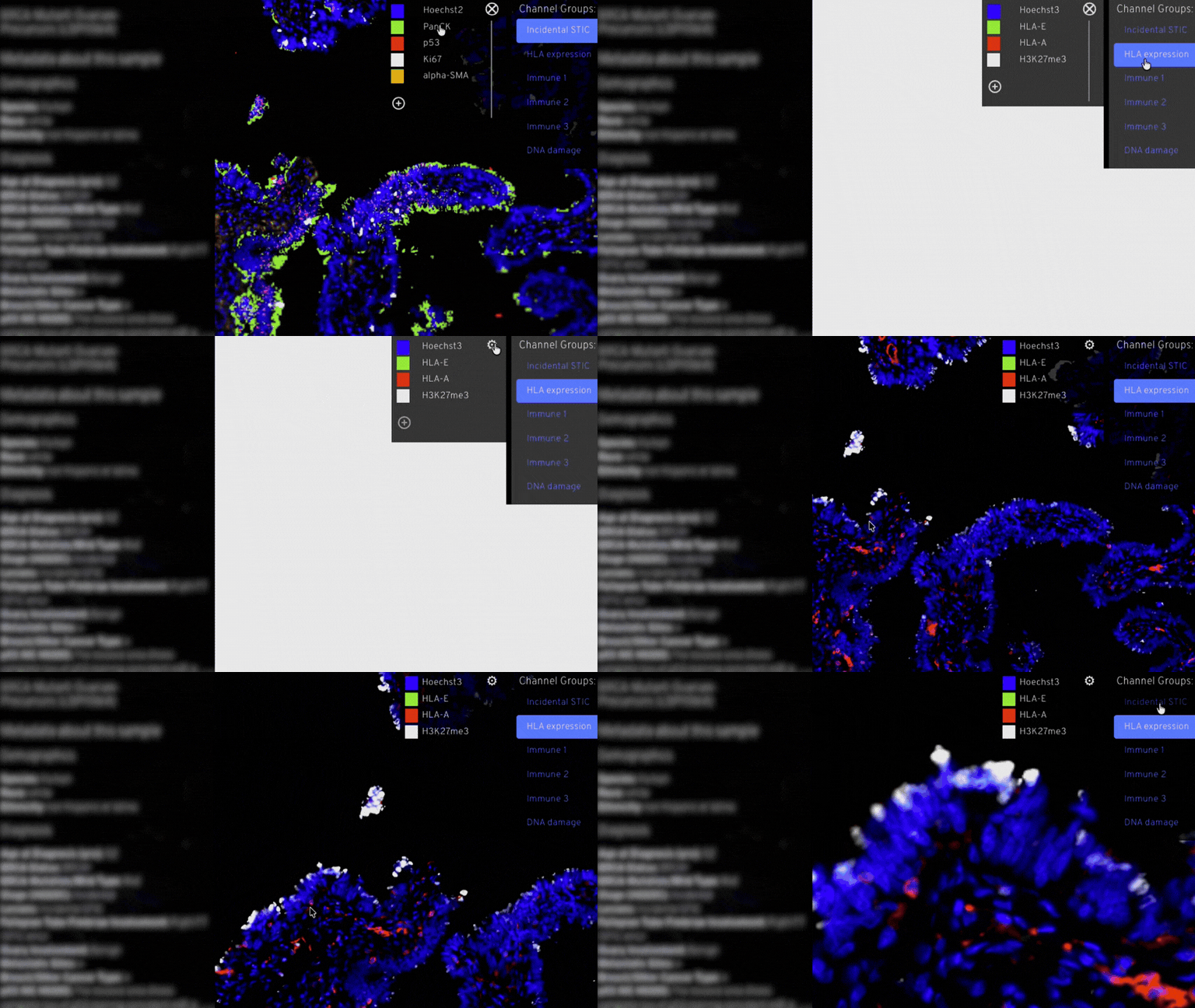
For researchers, the Discovery Lab is a new way to work together—sharing data, learning from one another, and moving discoveries forward more quickly. Our mission is to foster collaborative progress at global scale—connecting scientists and clinicians across institutions and geographies in a shared AI-powered environment built for real-time discovery.
Individual discoveries build on one another in real time in this AI-powered ecosystem, reshaping the research cycle from isolated studies to rapid, interconnected breakthroughs that can impact patient care immediately.
“The idea of the Living Lab is so exciting because people will be able to share their information. Researchers will be able to say ‘Hey—I need all the data you’ve got on a patient who’s got endometrioid ovarian cancer, Stage 3C, who’s lived five to ten years.’ And they’ll be able to access that and ask the questions we need answered.” — Susan Leighton, 28-year ovarian cancer survivor, Director of OCRA’s Survivors Teaching Students program, and Living Lab participant
Researchers in the Discovery Lab will have access to cutting-edge data analysis, visualization, and collaboration tools, supported by in-kind Amazon Web Services (AWS) compute credits. Together, the Discovery Lab and AWS are helping to democratize access to the tools global researchers need to drive discoveries forward.
What this makes possible
This is about more than building a new platform. It is about changing how research happens—and who gets to shape it.
If we do this together—if we connect what we know, share what we know and what we learn, and build on each other’s work—we have the opportunity to create a faster, smarter, more human model of discovery for everyone affected by gynecologic cancers.
“I am here because of research. I’m still alive because of research … I want to pay it forward and make sure that we eventually find a cure.” — Rebecca Esparza, 24-year ovarian cancer survivor and Living Lab participant